Know what to say before you press to transmit.
Learn the phraseology, then speak your calls aloud and hear ATC answer. Every call is checked on your phone, element by element: your callsign, the runway, the QNH, in the right order.
Two modules free7-day free trial£16.99 once, no subscription
ATC sounds like the radio. You sound like you.
Each controller has their own voice, through the hiss and roll-off of an airband receiver. Your readback is checked for what has to be read back. These are real recordings from the app.
Swap frequencies with ⇄ to hear Kingsford Approach through heavier static. Places and frequencies are made up for practice.
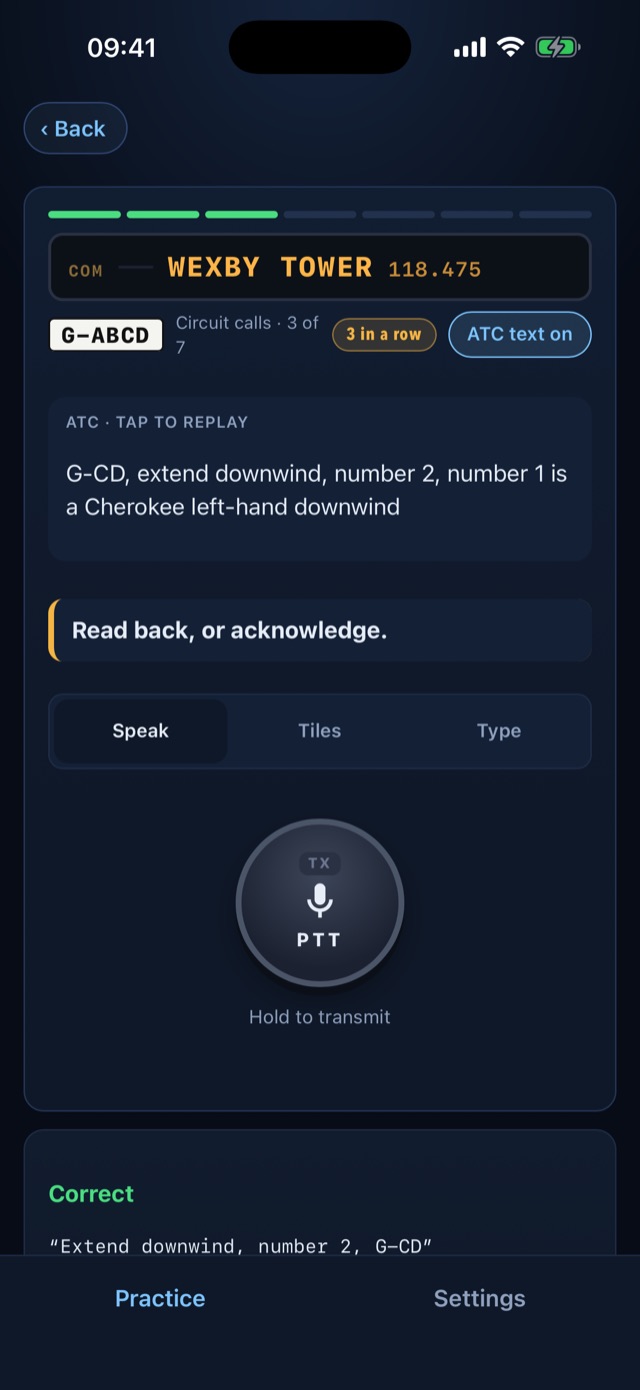
Listen. Press. Speak. See what was heard.
The same three steps as on the radio, with an instructor’s eye on each call.
ATC calls you
Hear the instruction on the radio, with its words on screen or hidden, as you choose. The exam module starts with them hidden.
Hold to transmit
Press the PTT and speak, as you would in the aircraft. Or answer with call tiles, or type: the app remembers how you like to answer.
Every element checked
Recognised on your phone, then marked against what the call must contain, with the reason when something is missing or wrong.
- ✓Runway 24
- ✓“cleared to land”
- ✗Callsign: heard G-LT
From the alphabet to a whole cross-country.
A practice area of its own, with ATC that answers back.
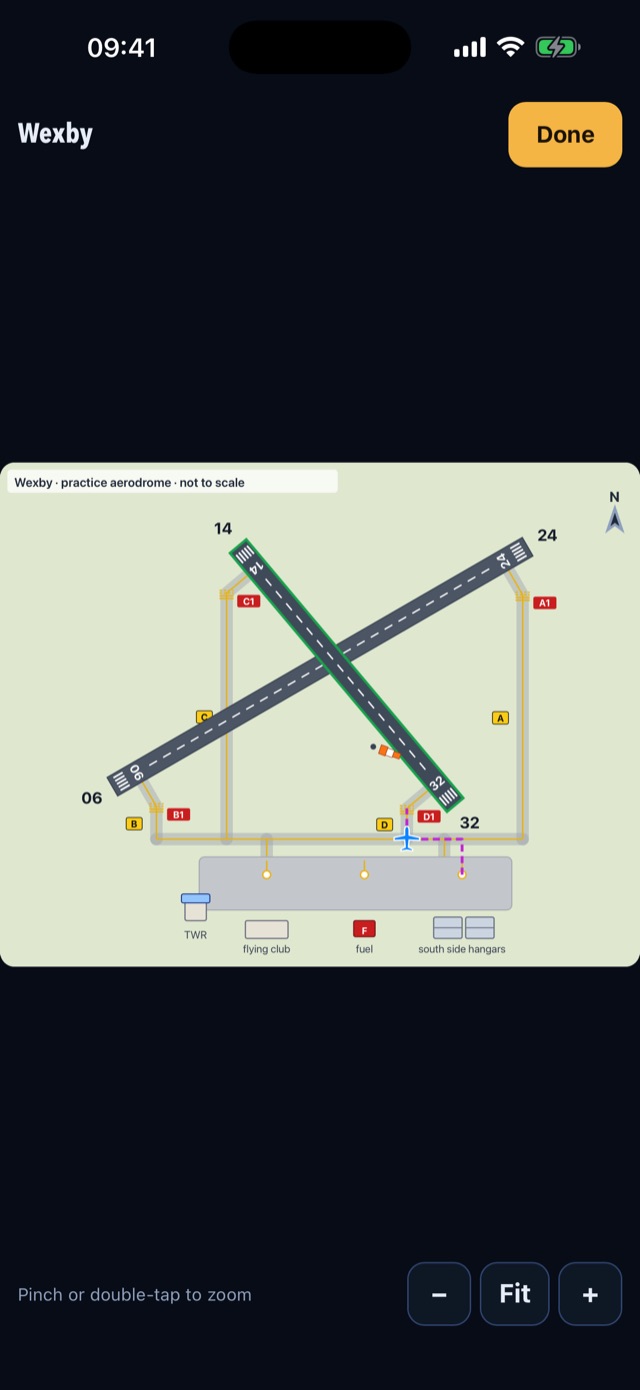
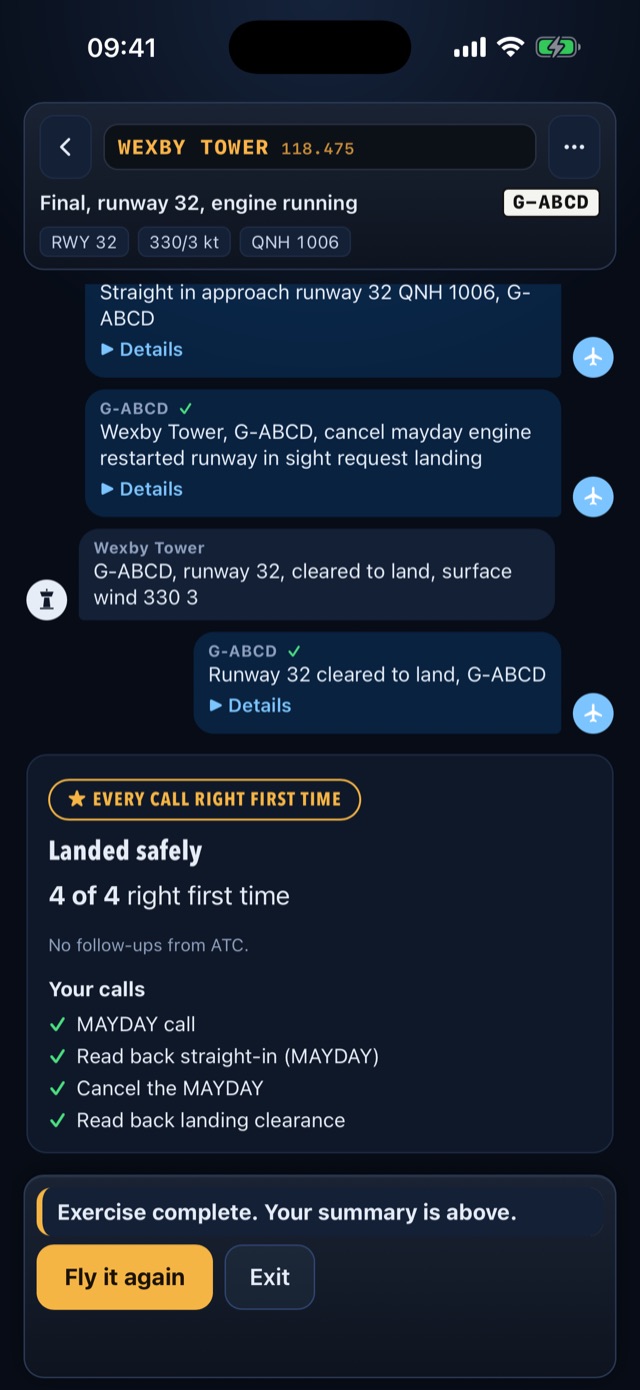
Downland is a made-up area with a tower aerodrome, a Class D zone, an AFIS field, an A/G station, a military zone and a farm strip. Fly from the apron to the zone boundary and on to your destination.
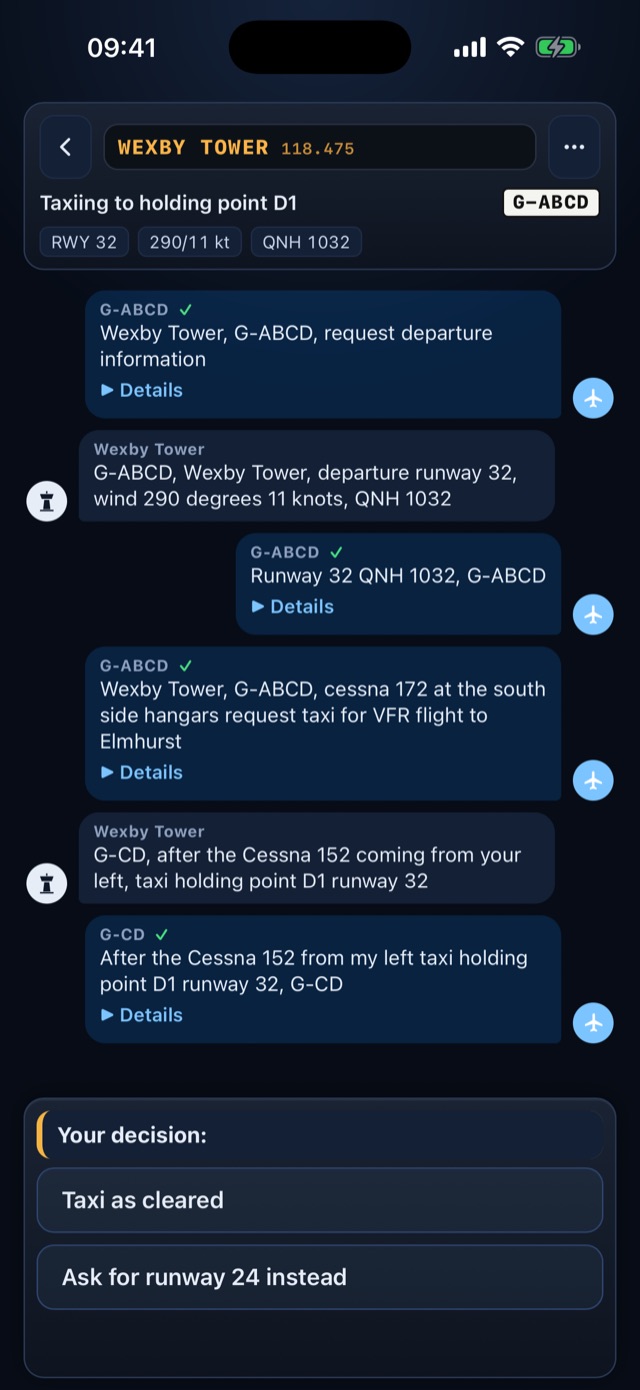
- ATC decides. Runway, wind, QNH, squawk and the route change on every run, and so does what Tower asks of you.
- Mistakes get handled. Miss part of a readback and ATC asks for it again, as it would on frequency.
- Your home aerodrome. Give Wexby your own field’s name and every lesson, flight and chart uses it.
The frequency isn’t quiet. Neither is the app.
A busy frequency
Other aircraft talk to ATC between your calls, some with callsigns like yours. Was that for you? Sometimes a call is blocked and you ask for it again.
Hands-free
For the car or a walk. ATC calls, you answer aloud after the tone, and the app tells you how you did. No screen needed.
A voice for each unit
Tower and Approach are two people. Choose English accents, or in Europe mode, controllers with local accents.
Your callsign
Set your registration and type. ATC calls you by it, abbreviates it once it has used it, and you’re marked on it.
UK or Europe
Calls follow CAP 413 in the UK, or the EU rules of the air (SERA) in Europe, where the two differ.
Mistakes come back
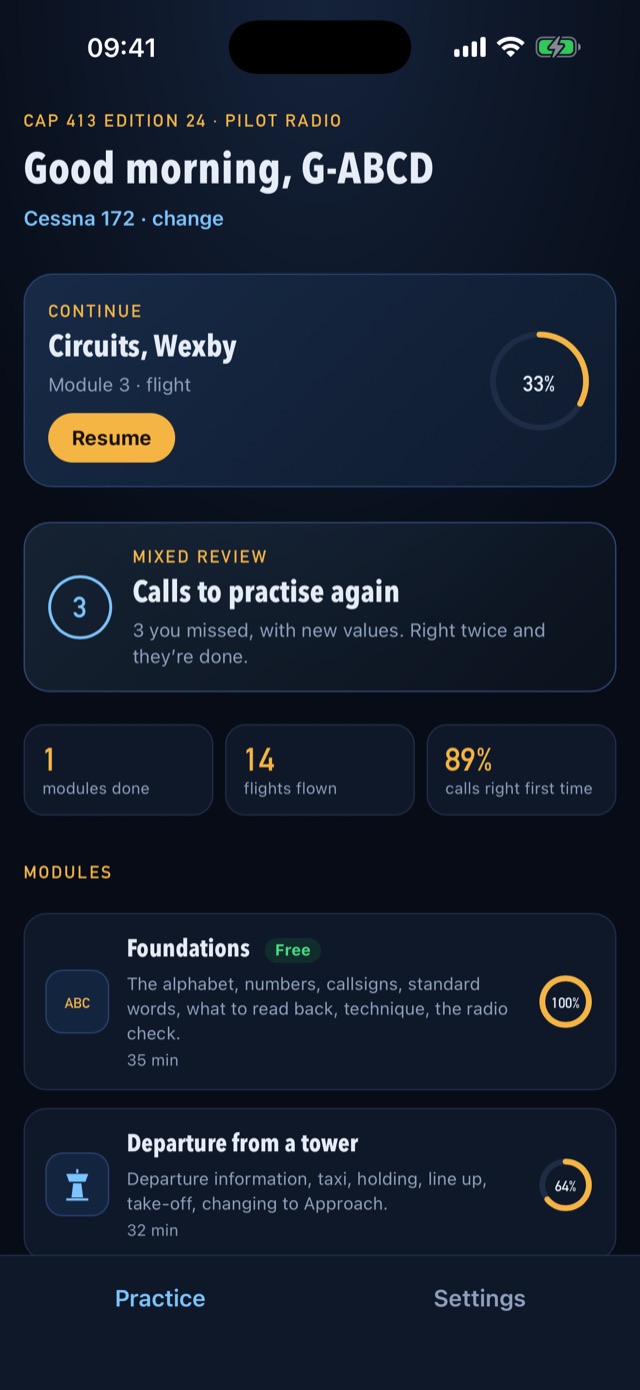
Calls you miss return in a mixed review with new values, until you’ve got them right twice.
Fly the test before you take it.
A route, the frequencies and the chart to plan on. Then the flight in exam conditions: ATC’s words hidden, traffic on frequency, no help with the call. At some point, an emergency. You have 30 seconds to start it, in full and in order.
Then the examiner’s questions, and a report by syllabus area that you can share with your instructor as a PDF.
The test’s shape follows CAP 2325. The report is our practice standard, not the CAA’s marking.
Example report. A practice assessment by the On Frequency app, not the CAA’s marking. Places, units and frequencies are fictional.
Eight modules, from the first word to the exam.
- 1FoundationsFree
The alphabet, numbers, callsigns, standard words, what to read back, technique, the radio check.
- 2Departure from a tower
Departure information, taxi, holding, line up, take-off, changing to Approach.
- 3Circuits
Downwind, final, touch and go, land, go around, vacating.
- 4Arrivals and joining
Request join, pass your details, overhead, downwind or straight-in joins, land, taxi in.
- 5AFIS, A/G and unattendedUK
Information and Radio stations: they inform, you decide. Unattended strips and SAFETYCOM.
- 6En route
Flight information services, crossing a control zone, squawks, position reports, RMZ, MATZ.
- 7EmergenciesFree
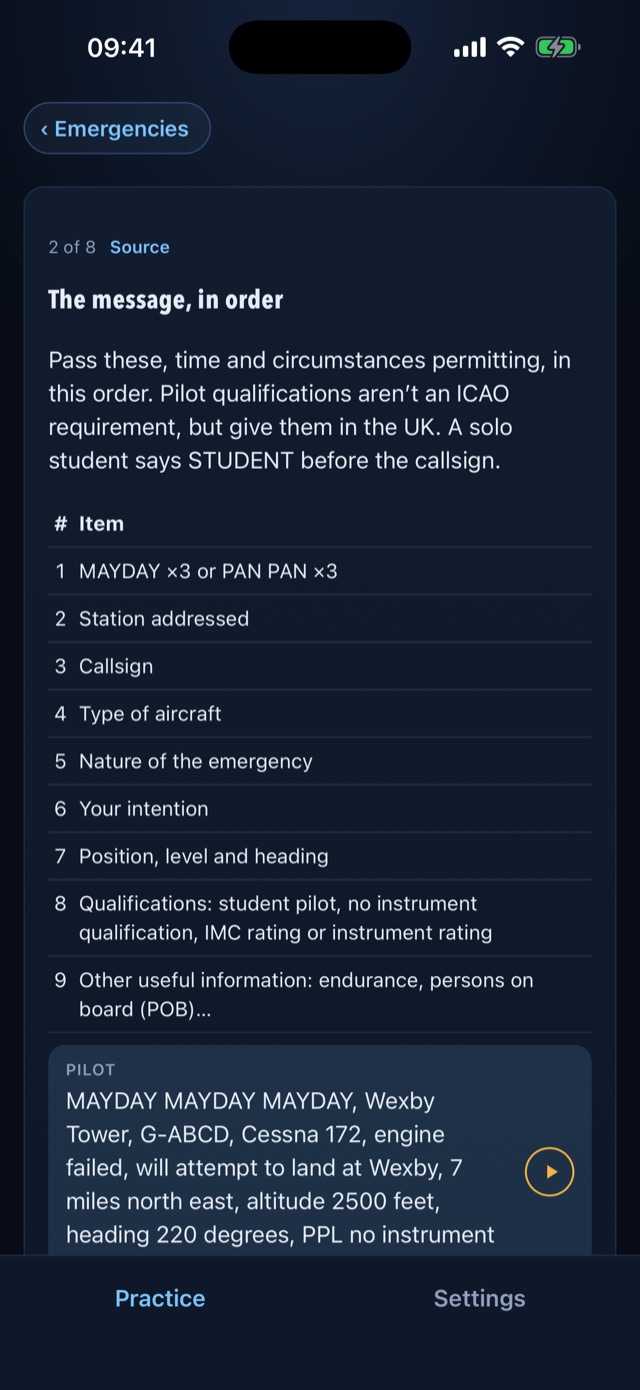
MAYDAY and PAN, cancelling, radio silence, relaying, radio failure.
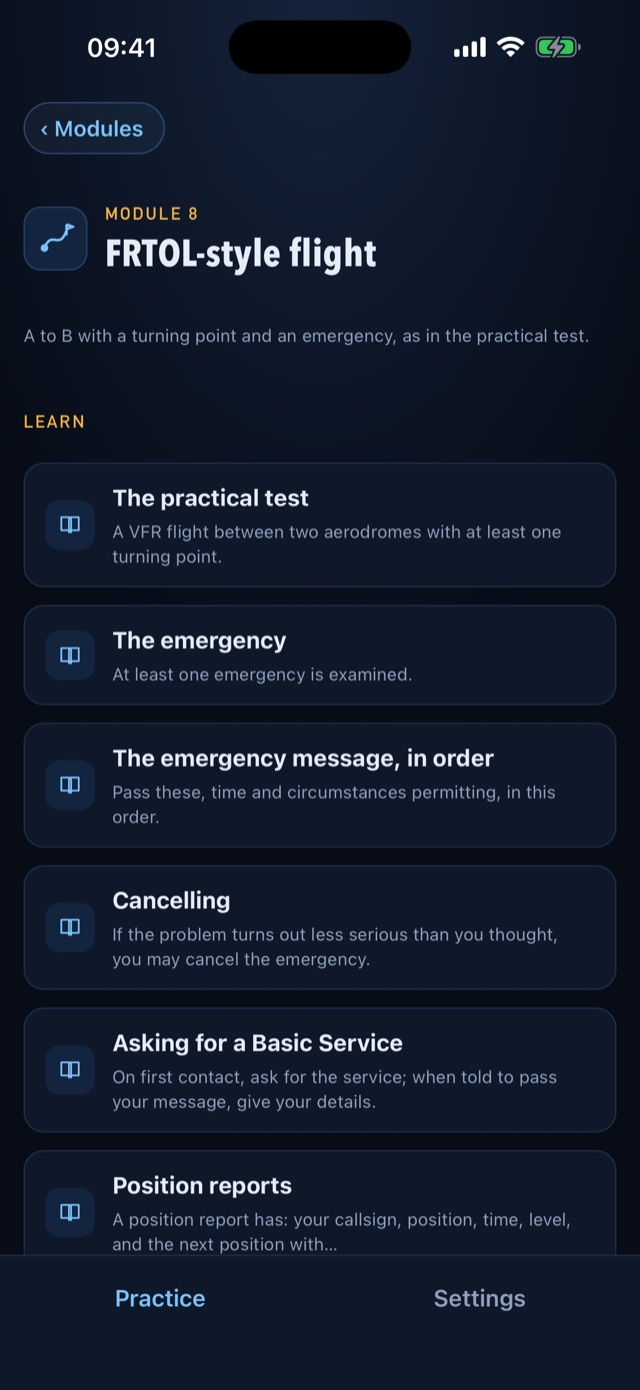
- 8FRTOL-style flight
A to B with a turning point and an emergency, as in the practical test. The examiner’s questions, and the mock exam.
Your voice stays on your phone.
Speech is recognised on the device. Your aircraft, your progress and your recordings stay there too, and recordings are cleared after 30 days.
- AccountsNONE
- Analytics and trackingNONE
- AdvertsNONE
- Speech sent to a serverNEVER
Pay once. Keep every module.
Start free
- Module 1: Foundations
- Module 7: Emergencies
- Free for as long as you like
Every module
- Try everything free for 7 days
- All eight modules, flights and the mock exam
- No subscription
Before you key the mic
Is this the FRTOL exam?
No. On Frequency is a training aid. It doesn’t replace training with your instructor or training organisation. The mock exam follows the shape of the practical test in CAP 2325 and marks you against our own practice standard.
Where do the calls come from?
In the UK, the phraseology follows CAP 413, the CAA’s Radiotelephony Manual (Edition 24). In Europe mode, it follows the EU rules of the air (SERA Section 14) where they differ. The examples, places and frequencies are our own and made up for practice.
What if it mishears me?
You can say you said it correctly, and it’s counted separately. You can also answer with call tiles or by typing, and switch at any time.
Do I need to be in the UK?
No. Choose Europe when you set up and the calls follow SERA, in a practice area with its own names.
Which devices does it run on?
iPhone and iPad.